
First of all, human resource planning is the guarantee of enterprises’ demand for human resources. For enterprises in a rapidly changing environment and fierce market competition.
The balance between the demand and supply of human resources cannot be automatically realized.
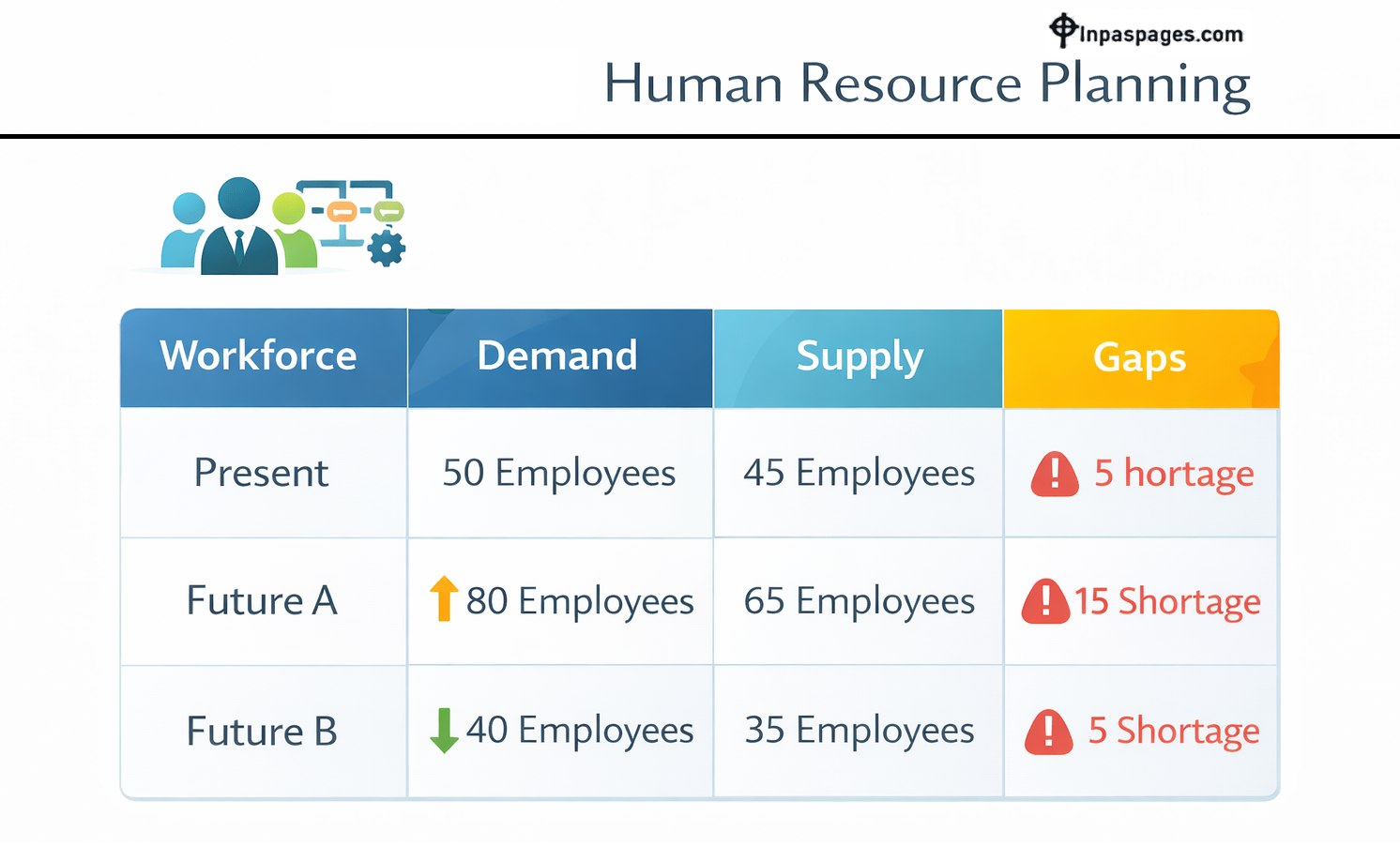
It is necessary to analyze the difference between supply and demand and take appropriate means to adjust the difference.
Which is the basic function of human resources planning.
Control Labor Costs
Human resource planning is an important means to control labor costs. The total salary of an enterprise depends to a large extent on the distribution of personnel in the enterprise.
Personnel distribution refers to the number of personnel in different positions and levels in the enterprise.
When an enterprise is small, the problem is not big, but over time, the number of personnel increases and the level of job levels rises, and labor costs may exceed the ability of the enterprise to bear.
In the absence of human resource planning, the future labor cost is unknown, difficult to control, and the efficiency of the enterprise is not guaranteed.
Therefore, when predicting the conditions for future enterprise development, “planning” becomes particularly important to gradually adjust the distribution of personnel in a planned manner and control labor costs within a reasonable payment range.
Basic management
At the same time, human resources planning is the basis of human resource management, which can also be said to be the “program”.
With the expansion of the scale of enterprises and the complexity of the structure, the workload and difficulty of management are rapidly increasing. Whether it is to determine the demand for personnel, supply, position, or the adjustment of positions and tasks. It is obviously difficult to achieve without a certain careful planning.
For example, when additional personnel are needed, at what levels of personnel, and how; How to organize training for multiple needs, how to evaluate and motivate employees at different levels and departments, etc.
In the absence of human resources planning, these management practices are bound to fall into fragmentation and confusion.
Therefore, human resources planning is an important basis for organizational management. Which will provide accurate information and basis for the organization’s recruitment, training, evaluation, incentives, personnel adjustment and labor cost control.
Employee Motivation
Finally, HR planning can fully motivate employees to work hard. Only on the basis of human resource planning can employees be guided in career design and development. Allowing employees to clearly see their own development prospects and actively strive for them is very beneficial to motivate employees.
Develop human resources planning.
We formulate human resources planning for enterprises, which are generally divided into five steps:
| First, analyze the strategy, business environment and organizational structure of the enterprise, which is the premise of human resources planning. Different product portfolios, production technologies, production scales, and operating areas will put forward different requirements for personnel. Demographics, laws, competition, and job expectations constitute multiple constraints to external manpower supply. |
| Second, analyzing the existing human resources of enterprises is the basic work for formulating human resources planning. To realize the corporate strategy, we must first base ourselves on the development of existing human resources. So we must adopt scientific evaluation and analysis methods. The human resources supervisor shall make statistics on the number, distribution, utilization and potential status and current ratio of various types of manpower in the enterprise. |
| Third, forecasting the demand and supply of human resources in enterprises is a key work with strong technology in human resources planning, and all human resource development and management plans must be decided according to forecasts. The requirement of the forecast is to indicate the remaining vacancies of the various types of manpower during the plan period. |
| Fourth, the formulation of the human resources development management master plan is a more specific and detailed work in the process of preparing human resources planning. Which requires human resources managers to put forward various requirements for human resources planning according to the forecast of human supply and demand. |
| Fifth, continuously supervise, analyze and evaluate the implementation process of human resources planning, find out the shortcomings of the plan, and make appropriate adjustments to ensure the realization of the overall goals of the enterprise. |
Six major views that need to be paid attention to in human resources planning
In many years of human resources consulting work for enterprises, we have formed some unique views on human resources planning:
1.
Headquarters and branches Headquarters and branch offices play different roles in the development and execution of human resources planning. Human resources planning is generally carried out by the headquarters and senior management institutions of the enterprise.
The headquarters considers the overall human resources according to the overall strategic planning of the enterprise, and plans the quantity, quality and structure of the enterprise’s talents according to the strategic goals achieved according to the needs.
The branches of the enterprise are more likely to formulate detailed implementation plans in accordance with the overall plan, and timely find and feedback problems in the process of implementation, and take corresponding adjustment measures.
2.
High-level and middle-level the senior management team of the enterprise has more and deeper thinking about human resource planning. It is often the top leader or vice president of human resources who dominates human resource planning, and the person in charge of the human resources department who makes the specific plan.
Therefore, HR planners should actively communicate with senior executives, clarify the company’s vision, understand the leadership’s intentions, and obtain executive buy-in.
Human resource demand planning should be treate differently according to different stages and different objects of the company’s development, highlighting the key points.
On the basis of objectively analyzing the current situation of human resources of enterprises, according to the requirements of enterprises to achieve strategic goals, find the gap between the current status of human resources and the goals, and then adjust.
For employees at the grassroots level, more attention is paid to the number of personnel and structural adjustment; Middle and senior managers should pay more attention to the improvement of personnel ability and quality based on corporate culture and business philosophy, and the transformation of values and behavior orientation.
3. Implementation, concept and form From
The perspective of large international and domestic enterprises, human resource planning is reflected in many concepts and specific implementation.
But not many in clear written form. Therefore, in the process of formulating and implementing human resources planning, enterprises should pay more attention to the core concepts and specific implementation measures of human resources planning, and pay attention to their specific implementation effects, without being limited to their specific manifestations.
In layman’s terms, excellent enterprises have human resource planning flowing in their blood, but not all of them have a thick dozen human resources planning documents,
4. Broad and narrow sense
To do a good job in human resource management, you need a three-step strategic planning – human resources planning – force resource management system and specific implementation plan. There is a relationship of “cutting continuously, and the state is still chaotic”.
In a narrow sense, human resource planning is the “program”. Human resource planning describes the quantity, quality, and structure of people a business needs to achieve future goals.
The overall strategic objectives of the enterprise determine the content of human resources planning, and these contents provide direction guidance and basis for the establishment of human resource management system. The formulation of specific personnel supplement plans, personnel use plans, personnel succession and promotion plans, education and training plans, evaluation and incentive plans, labor relations plans, retirement and dismissal plans, etc.
Therefore, human resources planning in a broad sense includes these specific elements.
Human resources planning is an important part of the strategic planning of enterprises, and it is also the foundation and basis for various human resource management work of enterprises.
5. Stability and change
When enterprises are in different stages of development and environments. The role and focus of human resource planning are also different.
When the enterprise is in a stable stage of development, human resource planning plays a greater role, and for middle and senior managers, enterprises pay more attention to their professional skills, industry knowledge and other factors.
When the enterprise is in a highly uncertain environment. The role of human resource planning will be reduce. For middle and senior managers, enterprises pay more attention to their comprehensive quality, general skills and other factors.
6. Static and dynamic the formulation
Human resources planning is often base on the company’s clear strategic development direction and goals. It is creates at a certain time base on the analysis, and judgment of the future. Which is a static decision.
When enterprises face a rapidly changing internal and external complex environment. They must make reasonable adjustments to the planning according to the changes in the actual situation to adapt to the environment and minimize the lag of response.
Therefore, human resource planning is dynamically adjust. Not once and for all, and the most important thing is to pay attention to its actual implementation effect.
At the same time, the previous year’s human resources plan may require to revise every year.
Cases & Comments:
Huawei’s Strategic Human Resources Planning: Seize the Talent Highland and Monopolize Reserve Talents
Huawei was once a little-known private enterprise, but in just over a decade, it has developed into one of China’s top 100 electronic information enterprises with the highest profit margin and the highest R&D investment rate.
One of the important factors for its success is the development of human resources planning and large-scale talent pooling in accordance with strategic planning goals.
After the mid-90s, after determining the strategic development direction of “Huawei will focus on the research and development of overall solutions for communication networks from the core layer to the access layer for a long time.
While providing users with an open service platform in the form of standard middleware, and paying attention to the development direction of broadband, grouping, and personalized networks”, Huawei carried out human resources planning and began large-scale talent introduction and reserve. From 1998 to 2000, the average annual growth of employees was about 3000-4000, ranking first in China.
Time scale
Taking 1998 as an example, in addition to continuing their studies at home and abroad, about 400 graduate students graduated from the University of Science and Technology of China in 1998 sought jobs, of which nearly 90 went to Huawei, while nearly 200 from Huazhong University of Science and Technology went to Huawei.
By 2001, Huawei had more than 15,000 employees, 85% of whom had bachelor’s degrees or above, and 45% had master’s, doctoral, and postdoctoral degrees, with an average age of 27. From the perspective of personnel structure: scientific researchers account for 40%, marketing and service personnel accounted for 35%, production personnel accounted for 10%, management and other personnel accounted for 15%. It is worth noting
that Huawei’s human resources planning is not modest, based on supply and demand forecasts, but more from the strategic perspective of cutting off the supply of competitors’ talents. It is this strategic initiative based on human resource planning that has laid a solid foundation for Huawei’s development, and at the same time has put great pressure on other competitors.
The core of AT&T human resources planning: pay attention to the quality model of top managers
In recent years, AT&T, like many multinational companies, has attached great importance to the ability requirements of required personnel, especially senior executives, in human resources planning. Companies need a “new type” of managers who have extensive knowledge of the company’s new products and services, the ability to manage acquisitions and mergers, and the ability to perform their functions effectively in an uncertain environment.
AT&T re-developed detailed human resources planning and focused on the qualities and skills of top managers, and solved the management problem of top management staffing by developing and implementing a career management system. The purpose of this system is twofold: first, to identify the management skills required by the company’s new global business plan; Second, track the skill levels of all existing managers aspiring to top management positions. Such a system would allow AT&T to “recommend” and ultimately select candidates when vacancies arise.
The system stores a wealth of information about AT&T’s personnel and positions. For example, a “people profile” includes information about each manager, such as work history, education, strengths and weaknesses, leadership development needs, development plans, training (attended and planned), and special skills (e.g., proficiency in a foreign language). For each targeted senior management position, the “Job Profile” lists things like the job title, location of employment, skill requirements (present and future), and possible successors to the position.
AT&T maintains the continuity of its organization’s senior leadership through human resources planning, specifically, describing the leadership skills required for different senior positions, understanding the employees who are qualified to advance to a defined position, and fully training and developing each candidate.
Practies
Through these practices, the company has a pool of qualified internal candidates from around the world from which to select should senior management positions become vacancies. Moreover, planning is quite flexible, allowing companies to react quickly to sudden changes in need.
For example, when a top management position in Paris suddenly hangs pending due to a merger, the system quickly identifies qualified candidates who speak fluently French.
The inspiration brought to us by this case is that when the environment changes drastically, because the number of talents at all levels cannot be accurately predicted.
The focus of human resources planning can only be on clarifying the basic qualities of leaders at all levels, so as to continuously discover, introduce, and train (10) people who lead troops, that is, let the captain and sailors board the ship first, and then decide where the ship goes.
It can be says that it responds to all changes with no change.
Peking University Vertical and Horizontal Human Resources Planning: Strategy-based Vertical and Horizontal Human Resources Planning Model
First of all, we have a basic judgment on the entire external environment: the market demand of the domestic consulting industry will maintain a rapid growth momentum in the next five years, and our share in this market will increase year by year, and maintain a leading position in domestic management consulting enterprises. Our strategic goal is to reach a turnover of RMB 200 million by the end of our third venture.
The second is to analyze the existing human resource situation. Our basic organizational structure will be a flat trapezoidal structure with partners at the top and consultants on the bottom.
Quantity:
The company has nearly 200 full-time consultants, including 8 partners, with an annual contract amount of more than 50 million.
Quality:
The basic characteristics of consultants are MBA or Master of Management doctoral degree, have certain management work experience, at the same time have strong communication and expression skills, strong logical thinking and analysis skills, adapt to the teamwork style.
The basic characteristics of partners are:
(1) love the company and highly identify with our corporate culture;
(2) Self-motivated, have a strong desire to succeed, continuous efforts
(3) High comprehensive quality, strong business ability. Outstanding ability to grasp customer needs and obtain orders;
(4) Strong team spirit, not only do their own responsible work, but also be able to cooperate with team members to complete the company’s work.
Then there are demand and supply forecasts. To maintain the leading position in the industry and a turnover of 200 million, taking into account that our per capita turnover will increase from the current 3077/person.
The annual increase to 400,000 / person.
This year, the team of management consultants will increase from the current 100 to 500, and the number of partners will increase to 50. From the perspective of the external human resources market and the internal training of the enterprise. We believe that these human resources planning can basically be achieves.
As a result, Peking University’s human resources planning based on strategic objectives has been clear in terms of structure, quantity and quality.
On this basis, personnel replenishment plans, personnel use plans, personnel succession and promotion plans, education and training plans, evaluation and incentive plans, etc. It can be formulating in detail.