
Production efficiency is the state of achieving more output at less cost by utilizing the least possible resources. It is also noted that it refers to the ability to produce maximum output using time, materials, labor, and energy without compromising the quality of the product or service process.
It is a concept that focuses on achieving maximum output using the least possible resources, without compromising on product quality or performance. When the market is highly competitive, there is a greater focus on reducing internal costs, increasing profitability.
Key Points
What does it actually mean? How does it work? We will see the exact information here. How can it benefit any manufacturing organization, and what we have to keep in mind. Here we will see the main points of manufacturing efficiency.
- Manufacturing efficiency is successful only when resources are used optimally. Such as raw materials, time and effort can be achieved with minimal waste. This is a part of an important system.
- When maximum production is to be achieved at minimum cost, the highest production level has to be achieved at the lowest operating cost. So that it becomes possible to increase manufacturing efficiency.
- It is very important for any process to be compatible with other processes. Which also applies to product quality. Even when efficiency increases, the output meets the required standards.
- It is ultimately necessary that when there are very few interruptions and downtime in the daily operation of machinery or equipment in the manufacturing areas. Which is possible through improved workflow. Improvement in workflow becomes possible through continuous study.
- When efficient production reduces the cost per unit and improves profit margins, it becomes easier for the manufacturer to compete in the market. Which can put competitive prices of the product in the market.
Over time, industries are increasingly adopting automation, lean manufacturing and data-driven decision-making. And this has also become strategically essential. But due to this, production efficiency can be easily measured, as well as improved, and it has become possible to explore production efficiency in depth.
How to Measuring Production Efficiency?
If a manufacturer measures production efficiency in its daily production areas, it helps it to understand the current situation and how well it is using its resources (machines, labor, materials and time) to produce output. Therefore, an attempt has been made to provide clear information with formulas, methods and examples below.
Production Efficiency
Production Efficiency (%) = (Actual Output / Standard Output) × 100
Example
Standard output = 1,000 units/day
Actual output = 850 units/day
Efficiency= (850/1000) × 100 = 85%
Labor Efficiency
Formula
Labor Efficiency (%) = (Standard Labor Hours / Actual Labor Hours) × 100
Example
Standard hours required = 400 hours
Actual hours used = 450 hours
Labor Efficiency = (400 / 450) × 100=88.9%
Machine Efficiency
Formula
Machine Efficiency (%) = (Actual Machine Output / Rated Machine Capacity) × 100
Example
Machine capacity = 200 units/hour
Actual output = 160 units/hour
Machine Efficiency (%) = (160 / 200) x 100 = 80%
Overall Equipment Effectiveness (OEE)
Formula
OEE = Availability × Performance × Quality
Components
Availability = Operating Time / Planned Production Time
Performance = (Ideal Cycle Time × Total Units) / Operating Time
Quality = Good Units / Total Units
Example
Availability = 90%
Performance = 95%
Quality = 98%
OEE= 0.90 × 0.95 × 0.98 = 83.8%
Cycle Time Efficiency (CTE)
Formula
CTE= Value-Added Time / Total Cycle Time
Example
Value-added time = 30 minutes
Total cycle time = 60 minutes
CTE= Value-Added Time / Total Cycle Time
CTE = 50%
Material Efficiency
Formula
Material Efficiency (%) = (Actual Material Used for Good Output / Total Material Input) × 100
Example
Material input = 1,000 kg
Material used in good products = 900 kg
Efficiency=90%
Production Efficiency Report
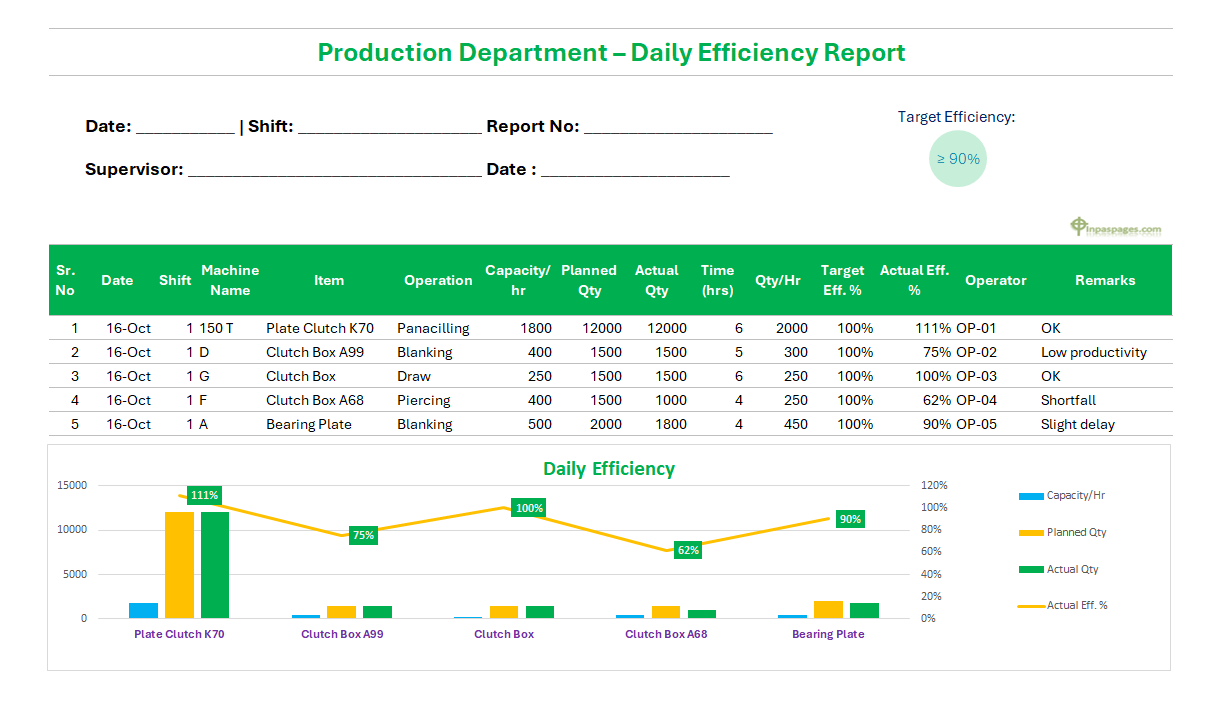
In manufacturing sectors, the capacity of a production system can be measured in terms of production efficiency. It is the ability to produce the maximum quantity of quality products using the minimum resources such as labor, materials, machines, time and energy. It also has to be seen that the factors that directly affect cost, productivity, quality, delivery time and profitability are taken into account.