
Performance monitoring is a systematic process that keeps an eye on current performance. Specifically, it measures and analyzes the performance of methods, processes, or resources against predetermined goals, standards, or key performance indicators.
This helps the organization identify SWOT (Strengths, Weaknesses, Variances, and Opportunities) and achieve its objectives efficiently and effectively. It is natural that it answers the main questions that arise in the business about current performance.
- It becomes easy to get information about the performance of the business.
- Based on this, it is easy to understand whether the business is achieving the pre-determined goals or not.
- If there are any improvement needs in the business at present, it can be understand.
Performance monitoring is used in production units, assembly units, etc. where different machinery and equipment are used along with resources, it becomes very important to know what is happening at present. In fact, it becomes easy for business managers to take decisions based on performance monitoring.
Why is performance monitoring important in manufacturing units?
Because a large number of different machineries, equipment, and resources are used within manufacturing units. It is essential to monitor the individual or collective performance of all of them. So that if there is an opportunity for improvement, it can be implemented. Also, decisions can be made based on performance monitoring for quality assurance and quality control in manufacturing. Here we will discuss other reasons.
Ensures product quality consistency
In any manufacturing sector, when it comes to product quality, it becomes a serious issue. Because to maintain a business in the market, the quality of the product has to be taken care of along with the price. So, constant monitoring has to identify the variations and abnormalities in real time so that a uniform quality is maintained.
Early detection of defects
Manufacturing sectors have many processes, and each process is linked to other processes on the line. Usually, the final product is inspected. But if there is performance monitoring at each process stage of the production line, it becomes possible to find and diagnose problems during the process. Thus, rework and scrap can be prevented.
Improves customer satisfaction
When continuous performance monitoring is done in the manufacturing areas, it is obvious that the possibility of any defect or spoilage during the processes is reduced. Because by identifying and eliminating defects during the processes, the quality of the product is maintained. As a result, there are no customer complaints. Which shows customer satisfaction.
Supports compliance and certification
All international quality standards certification bodies such as ISO, IATF, or Six Sigma require documented evidence for internal audits. So that systematic performance monitoring can present documents covering the processes.
Reduces the cost of poor quality (COPQ)
Those who regularly create or monitor poor quality statistics can easily understand that continuous performance monitoring is essential to control internal and external failure costs. Through which negative actions such as scrap, rework, recalls and penalties can be reduce.
Enables data-driven decision making
Performance monitoring is not just about monitoring processes, but also collecting and analyzing all the information about the processes. The results of that analysis are obtained, based on which business decisions are made. In this, no decisions are made based on assumptions, all the information about the actual performance becomes accurate and effective for making improvements.
Keeping quality in mind, what should be the objective?
Product quality is paramount for any manufacturer. In which the aim is to improve the efficiency of processes, machinery, equipment and resources, along with their operations, to ensure that they are more efficient.
- Performance monitoring is necessary to fulfill the purpose of aligning production processes with quality policies and business objectives.
- To ensure that all products are in accordance with the established design and customer specifications.
- All process capabilities in the production area should be maintained according to stability criteria.
- Performance monitoring is necessary to reduce defects in processes, or scrap and rework from processes.
- To find out where the main causes of quality problems are.
- Performance monitoring is useful for improving productivity without compromising quality.
Apart from that, there are many other issues for which performance monitoring is consider useful to meet business objectives. For example, if the manufacturer wants continuous improvement in the workplace, or if reviews are provides by management and auditors, then performance monitoring is very useful to support it.
Key Elements of Performance Monitoring
| Process Performance | Monitoring process parameters | temperature, pressure, speed, time, and flow |
| Product Quality | Evaluation of characteristics | dimensions, weight, surface finish, strength, functionality, and appearance |
| Machine Performance | Performance Analysis | Tracking machine efficiency, breakdown frequency, calibration status, and maintenance effectiveness |
| Material Quality | R.M Quality | Monitoring incoming raw materials, components, and supplier quality performance |
| Manpower performance | Skills & Development | Assessing operator skill levels, adherence to work instructions, and training effectiveness |
| System Performance | System Improvement | Reviewing standard operating procedures (SOPs), work instructions, and quality systems |
Performance Monitoring Sheet
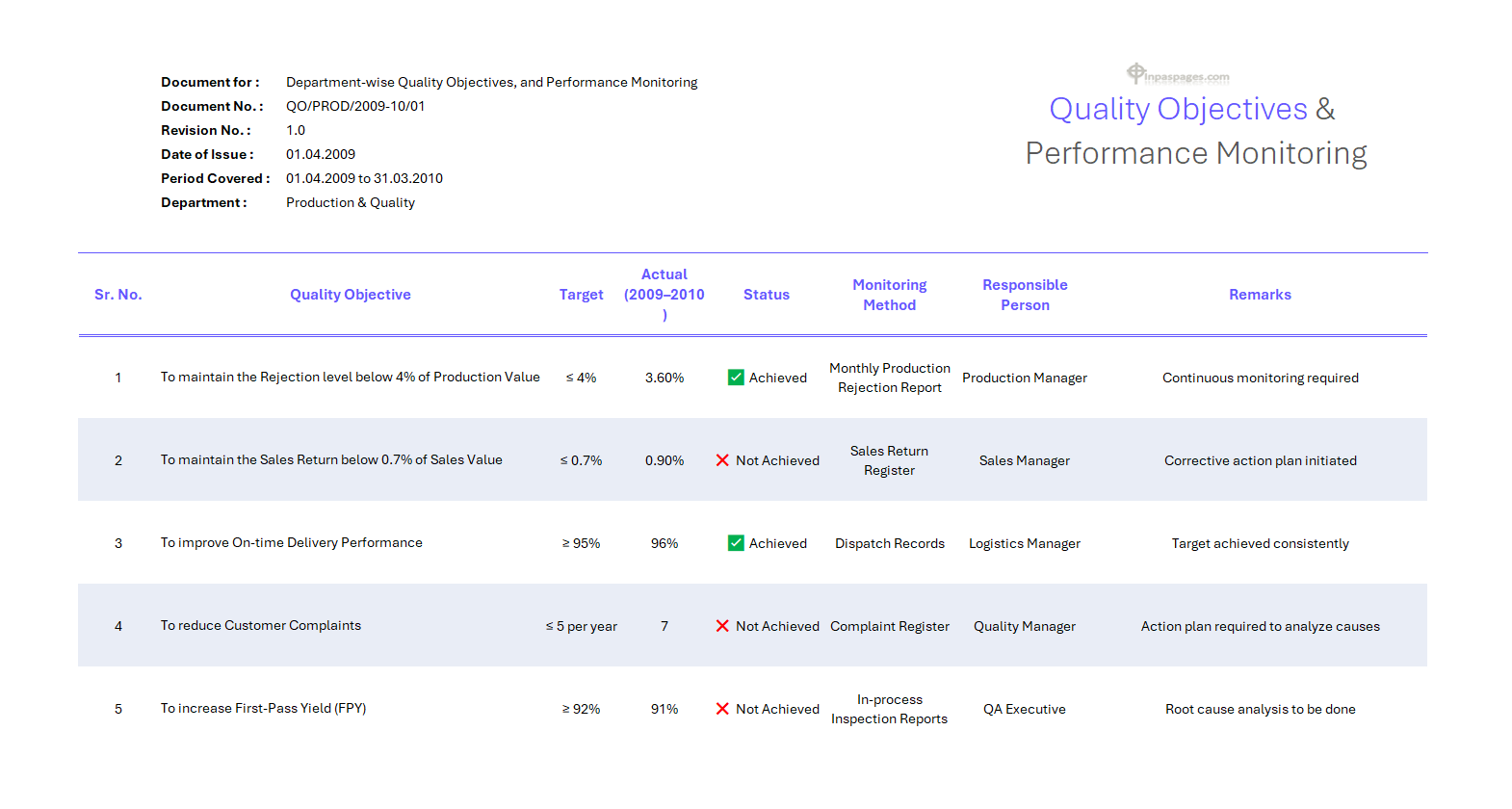
Performance monitoring helpful to monitor waste arising in production processes at each stage in the sequence of various processes on the production line. It can also cover important aspects such as efficiency, downtime.
Performance monitoring plays a major role in maintaining quality management in manufacturing units. It helps in achieving goals such as stable production processes, production as per customer specifications, and continuous improvement in the field.