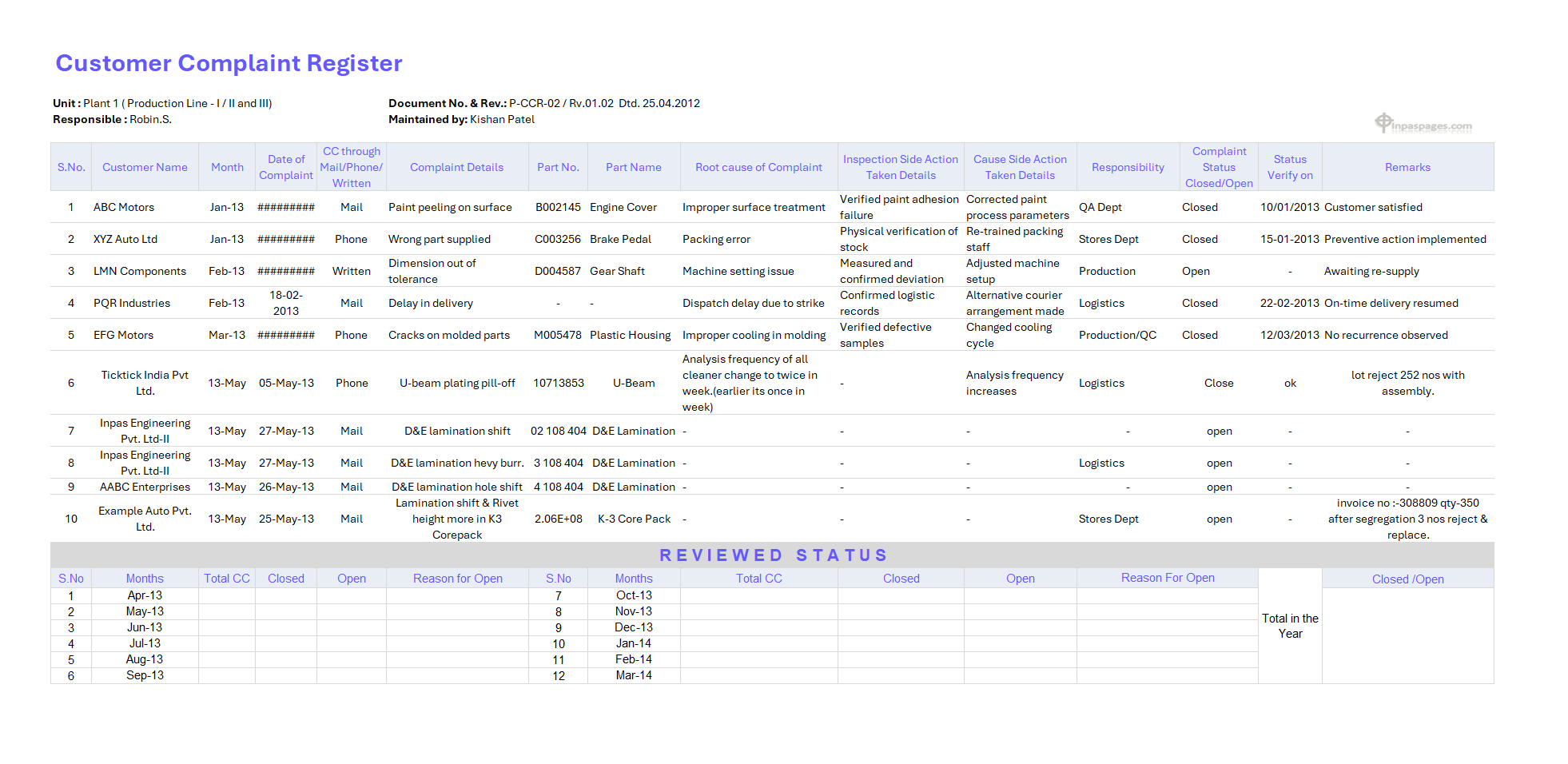
Customer complaint register
A customer complaint register is a record of complaints received from customers regarding products, services, deliveries, documentation or any other aspect of business operations. It is a formal document or system used to record, track, investigate and resolve complaints.
In essence, it helps to understand what customers are satisfied with and what they are dissatisfied with. The register includes information on corrective and preventive actions, the cause, the person responsible, the nature of the complaint, and the steps taken to resolve the complaint.
- It becomes easy to ensure immediate acknowledgement and resolution of any type of complaints from any customer.
- If there is a recurrence of any similar type of problems in the production area, it can be prevented.
- Improvement in the quality of products and services is possible only if the manufacturer is aware of the current problems, customer needs, and the feedback received from customers for the product.
- This is a tool to increase customer satisfaction and trust.
- If we are following international standards, then compliance with quality management systems has to be supported.
- This is a kind of repository, from which information is easily available for performance monitoring and management review.
In short, when we want to control the quality of the product effectively and transparently, then this register is beneficial for that.
What is the importance of a customer complaint register?
Customer satisfaction and retention
This register records the customer’s expectations and their experiences with the product. Based on these records, management can ensure that no complaint is ignored and corrective action is taken immediately. So that customers see that their complaints are listened to, as well as their concerns are taken seriously. So that their trust in the organization increases.
Quality improvement
It is natural that even after quality inspection, when the product reaches the customers. Often, product defects are revealed with or in the final product. So that complaints come from the customer about weaknesses in processes, materials, design or training. By analyzing the trends of such complaints in depth, organizations can identify systemic problems and implement corrective and preventive measures.
Regulatory and Standards Compliance
Every international standard has a rule that it is mandatory to document complete information about customer complaints. Also, it has to be presented as evidence by management during internal audits. So that the information contained in the register is taken seriously.
Risk Reduction
If the manufacturer has not taken into account the complaints and has not resolved them, then such complaints can create legal problems. Thus, the reputation in the market is damaged. If the complaints are systematically registered and necessary action is taken on them, it helps in identifying the risks early and reducing them.
What are the types of customer complaints?
Product-related complaints
- Can be about dimensional defects of the product.
- Any type of functional failure that directly affects the product.
- Complaints can also be about material inconsistencies.
- Performance problems are also product-related issues.
Service-related complaints
- In cases where customers receive poor, delayed response or no support from the manufacturer.
- Inadequate technical support can be a serious problem for customers.
Delivery and logistics complaints
- Frequently receiving late delivery of goods.
- The quality or quantity of goods is less or more than the quantity ordered by the customer.
- The customer suffers transit damage.
Documentation complaints
- Frequently receiving incorrect or erroneous invoices.
- Complaints about missing certificates
- Goods are received with incorrect labeling.
Process-related complaints
- Repeated problems with the product.
- Incorrect order taken in process.
- Poor coordination.
Grievance Redressal Process
Receipt of Grievance
The grievance redressal process starts with the receipt of the grievance from the customers. Grievances are received through emails, phone calls, letters, online portals or customer visits. Such grievances should be immediately recorded in the register.
Acknowledgement
After registering the grievance of the customer in the register, the customers should be informed that their grievance has been received, and that their grievance is being reviewed accordingly.
Grievance Evaluation
In fact, this is an important part of the process. Here, during the review, the seriousness of the grievance and its impact are determined. So that a complete understanding of the grievance can be made and a solution can be found.
Root Cause Analysis
When a grievance is received, it is very important to analyze the grievance. Therefore, an attempt is made to identify the underlying causes by using different analysis tools for analysis. Analysis tools such as 5 Why Analysis, Fishbone Diagram or Pareto Analysis etc.
Corrective Action
When the analysis process is completed, it is known what the causes are in fact responsible. Those root causes are eliminated in the current situation on an immediate basis.
Preventive Action
After the analysis, and corrective actions are taken based on the customer complaint, it is very important to take preventive action to prevent this type of error or defect from occurring again.
Verification of effectiveness
The processes are not completed with analysis, and corrective actions or preventive actions alone. It is very important to ensure that the measures taken work properly. Also, the measures have effectively eliminated the problem.
Closure
Where applicable, the complaint is formally closed after verification and confirmation of customer satisfaction.
Customer complaint register