
Inventory Ratio | Tracking Sheet
Inventory ratio is also calling inventory turnover ratio. It is actually, financial metric that describing efficiency of business, how quick sells and replace its inventory during a specific period of time.
The formula of the inventory ration is:
Inventory Ratio = Cost of Goods Sold (COGS) / Average Inventory
High inventory ratio mean, products are selling very fast, its show efficient inventory management
Low inventory ratio mean, products are selling slow, it is indicating overstocking, and poor demands.
Calculating the inventory ratio is much helpful, and important for any kind of manufacturing unit. It may help to maintain the accurate stocks, improve the flow of cash, reduce storage requirements, and also helpful for forecasting and planning the inventory.
Example:
Inventory Ratio = Cost of Goods Sold (COGS) / Average Inventory
Cost of Goods Sold = Total cost of product / Purchasing items sold
Average Inventory = (Opening stock + Closing stock)/2
Monthly details:
COGS = $10,00,000
Average Inventory = $2,00,000
Inventory Ratio = 10,00,000 / 2,00,000 =5
Means, Business Sell, and restocked its stock five time in a month.
How to ensure good or bad inventory ratio?
It is easy to ensure the ratio is Good or bad. There are actually depends on some factors, and industry standards. Usually, when you know your inventory’s industrial standards, remains can be decide as per business historical performance, customer demands and stock movement’s pattern.
As per my knowledge, industrial standard inventory ratio can be considered as below:
Grocery and food = 10 to 20+ is good
Retails and fashion products = 4 to 8 is good
For Manufacturing = 2 to 5 is Good
and luxury products = 1 to 3 is good.
Check your product and consider as per your product grade.
If you wish your business’s inventory efficiency, raw material flowing and want to avoid excessive stock condition, as well as prevention of production stoppages. You have to track the inventory ratio.
Inventory Ratio Tracking
An inventory ratio tracking is process of monitoring, measuring, and analyzing inventory turnover. To avoiding excessive inventory, storage costs, and preventing overstocking, tracking sheet helps to identify and prevent it. The tracking of inventory ratio is monitoring process, may help to maintain the accurate / right stock balance. If you balance is accurate, definitely the cash flow will be improving. The fast-moving inventory may flow the cash fast accordingly. The strong liquidity may provide better purchasing power.
This excel tracking sheet is actually helpful to understand product and its demand trends. Hence, the analysis of the trend may help to plan and making a strategy. Check the excel tracking sheet as below for reference:
Tracking sheet
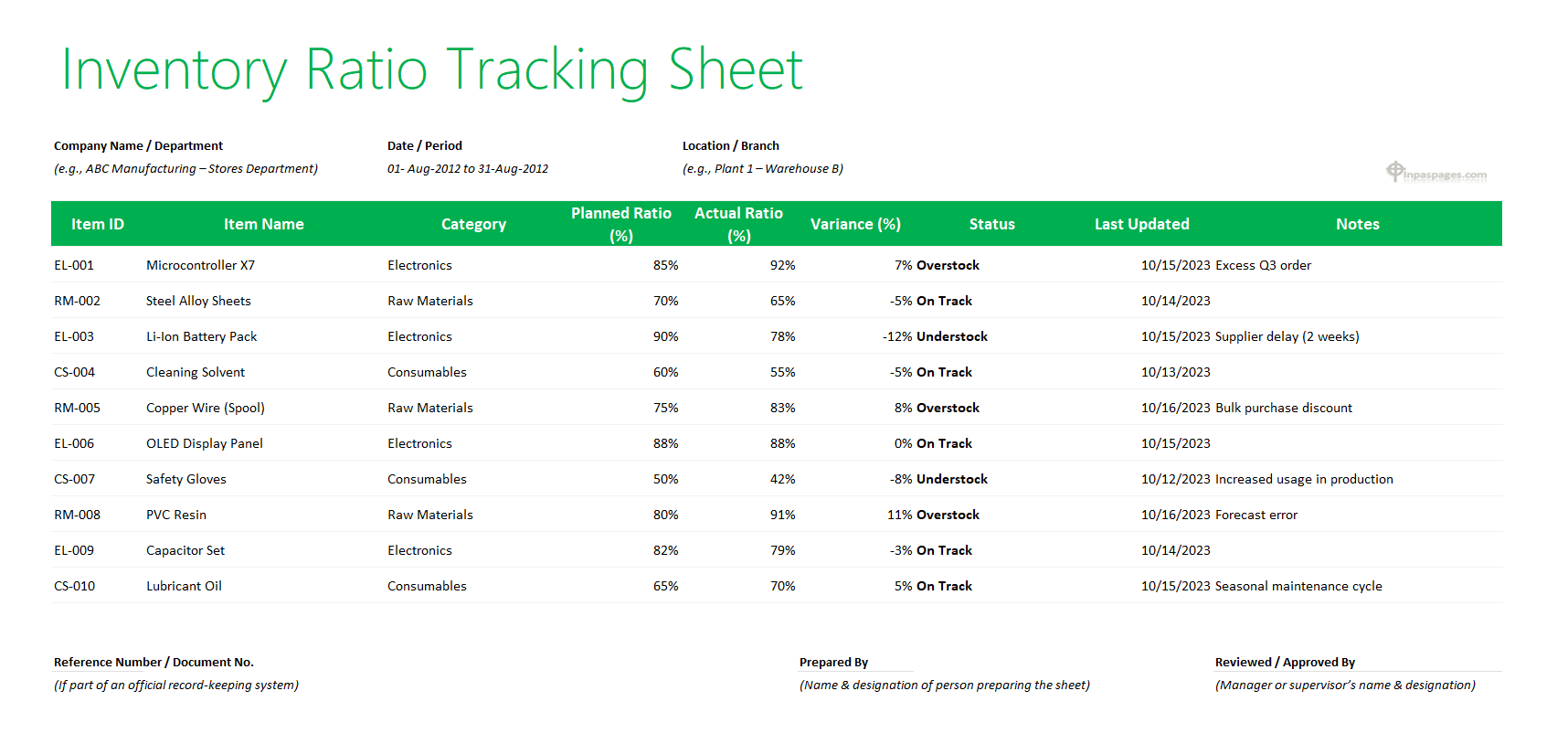
An inventory ratio tracking sheet is not just spreadsheet. It is records and analytical tool for inventory system. This tool helps to ensure that the stock movement and its ratio. This tracking sheet is systematic document that may helpful in manufacturing, raw material and finish goods warehouse. This tracking sheet use to monitoring ratio to review the planning and actual stock availability.