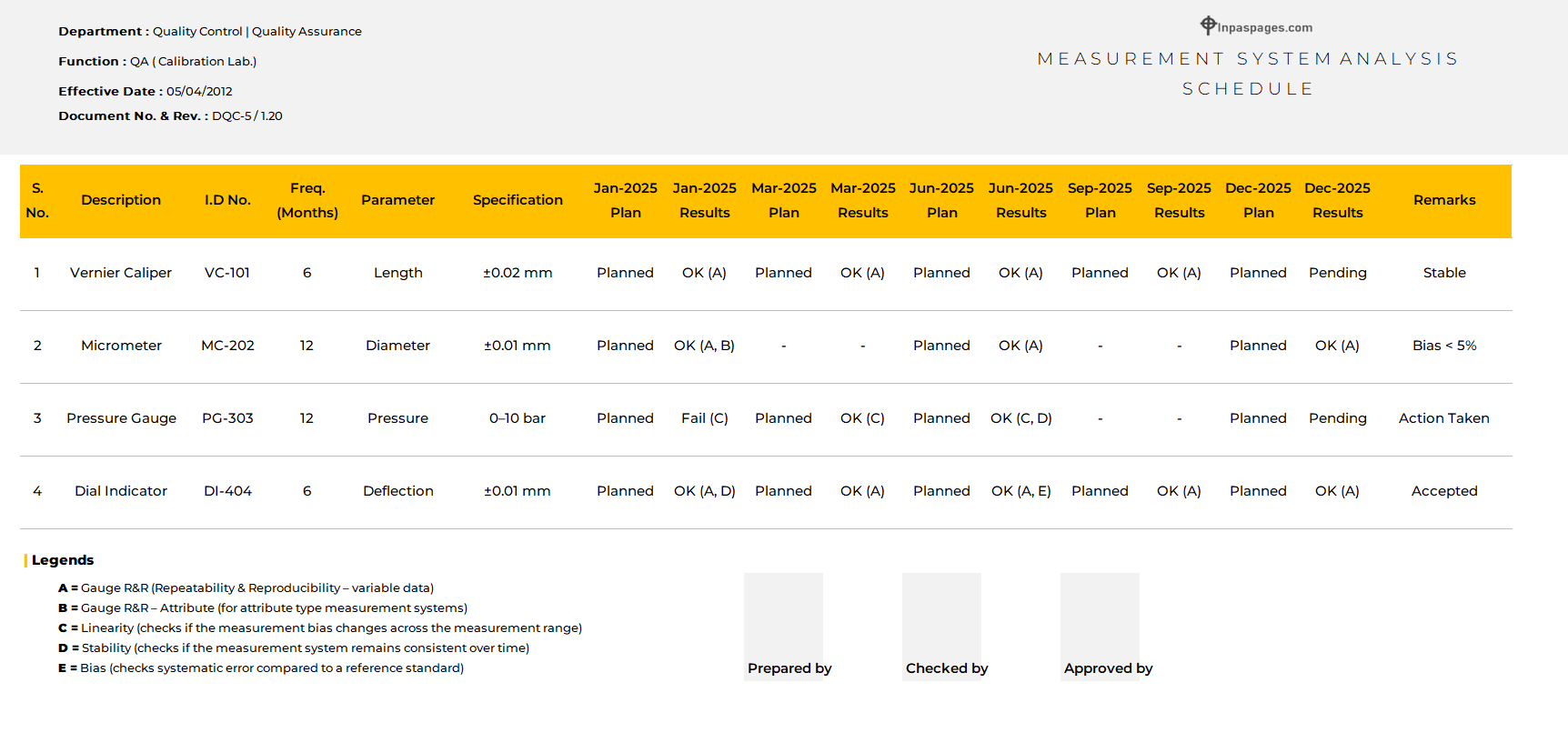
A measurement system analysis schedule is a structured, time-based, planned list of when, how often, and on which measurement systems MSA activities will be performed to verify that measurement results are accurate, precise, stable, and reliable over time.
It is commonly thought that a measurement system is simply measuring a product unit so that its specific dimensions can be identified. But in reality, a measurement system is a comprehensive process. It does not only encompass the measuring equipment or its process but also includes many other things.
- To operate measurement systems smoothly and for accurate measurements, special types of devices are required. Such as vernier calipers, micrometers, CMMs, gauges, sensors, balances, test rigs, etc.
- For accurate measurements and proper use of measurement devices, it is very important to design and operate the measurement system or process in production areas.
- Incorporating a measuring operator or evaluator into the measurement system makes the information and processes accurate and excellent.
- It is very important to operate the processes keeping in mind the environment (temperature, humidity, vibration, light). Because the environment affects the measurement processes.
- The part or characteristic being measured should be included in the processes keeping in mind.
It is necessary to understand the seriousness of the measurement systems and make a schedule for it, so that the measurement system can be statistically evaluated through analysis.
Why is MSA schedule important in manufacturing units?
Ensuring data integrity
In any type of manufacturing sector, decisions made by management are based on information. It is very important that this information is accurate and precise. Here, it can be understood from the MSA schedule that the information for which the measurement systems are, and the measurement of the product will be correct, so that the information becomes reliable. It is important to understand that without a reliable MSA, measurement errors can remain hidden for a long time.
Preventing costly quality problems
If measurement systems are not used in the manufacturing sector, it is natural that errors and defects remain in the processes. It is possible that serious errors such as rejection of good parts, or acceptance of bad parts can occur during inspection. As a result, increased scrap and rework occur. Thus, problems such as customer complaints and returns arise.
Compliance with standards and audits
It is natural that customers often ask for evidence of MSA. Which is considered necessary for quality management standards and customer audits.
The schedule shows a systematic control. So that the standards and audits are followed.
Supporting continuous improvement
The MSA schedule is part of the measurement systems. While process improvement initiatives such as Six Sigma or Lean require accurate data. So, the MSA schedule gives confidence that the improvement efforts are based on reliable measurements.
What is included in the MSA schedule?
An effective MSA schedule in a manufacturing facility includes many things. Which complete the measurement results and make them more prominent.
Identification of measurement systems
When we talk about measurement test methods, it identifies the measurement systems by all the gauges, instruments, and test uses used in them. In which product acceptance, key process characteristics, regulatory or safety-related measurements are identified and listed.
Classification of measurement systems
The MSA schedule can be enhanced or made more useful by adding necessary information. Such as classifying the systems to give them more seriousness such as critical (affecting safety, function or customer fit), major (affecting performance or appearance), minor (internal monitoring). This classification helps in defining the MSA frequency.
Type of MSA Required
The MSA schedule for measurement systems in a manufacturing facility determines whether gauge R&R, linearity, stability, or combination is required.
Frequency of MSA
The most important thing for measurement systems and their processes is to include information on the frequency of MSA in the MSA schedule. Such as
Common frequencies include:
(1) Annual for stationary, low-risk gauges
(2) Quarterly or biennial for critical gauges
(3) MSA is required after repairs, relocations, or modifications, and after process changes or customer complaints.
Responsibility and Approval
In manufacturing areas, and for measurement systems, the MSA schedule specifies who performs the MSA, who reviews and approves the results, and this responsibility is determined by who.
The schedule becomes more important based on such information.
Developing an MSA Schedule
Depending on the industry in the manufacturing sector, what to add and what to subtract from the MSA schedule depends on the unit. It really depends on its needs. But here are some general steps that should cover almost any type of industry.
Create a master gauge list
The MSA schedule is a master list of gauges used for actual measurements. This list is noted below.
(1) Gauge Id
(2) Description
(3) Measurement range
(4) Location or process
(5) Calibration condition
(6) Mobility
Identify important characteristics
When we talk about criteria, not all criteria require the same level of analysis, so we give importance to what is necessary and important, such as:
- Customer-Specified Characteristics
- security or regulatory parameters
- Tight-tolerance parameters
Select the appropriate MSA methods
- For variable data, gauge R&R is commonly used.
- For attribute data (go/no-go), attribute agreement analysis may be required.
Define frequencies and triggers
When we make the schedule, we keep the current conditions in mind. But sometimes it happens that new events which are called event-driven make it necessary to make changes. such as:
- New gauge introduction
- Operator change
- Change in measurement method
Documenting the schedule
We can also make the MSA schedule in the form of a table or a matrix. But a good format is more visual and a clean document is beneficial. In short, its documentation is very important.
Measurement System Analysis Schedule