
Hazard Observation Card is a formal report, useful for observing and indicating potential hazards, unsafe acts, unsafe conditions in the workplace. Based on this document, the inspector identifies and records hazards associated with production processes, or resources in the work areas, methods or resources.
Due to this report, corrective actions can be taken on them before they cause accidents or injuries in the work areas. Thus, a strong safety culture is promoted. As well as helping in taking corrective actions.
When there is a question of employee safety in production areas, there is no compromise. Therefore, this card is sent to the relevant safety department or supervisor for review, further investigation and corrective action. The hazard observation card is created based on three basic questions.
- What unsafe condition, or act was observed in the production areas?
- Where (location) and when (time) was it observed?
- What steps need to be taken to eliminate or control the detected or recorded hazard?
In fact, the main purpose of this card is to identify hazards early and prevent injuries, property damage, environmental damage and product damage in a timely manner.
What are the objectives of the card?
In any manufacturing sector, many different processes are running simultaneously. Also, heavy machinery and equipment are used in these processes. It is natural that such processes may have some or the other risks associated with them. To eliminate them, it is necessary to inspect them from time to time. Here we will discuss the objectives of the risk inspection card.
Early risk identification
Whenever there are signs of an incident or accident in machinery, equipment or resources. The main purpose of this inspection is to identify potential risks before such signs lead to accidents or incidents. If the incidents are reduced or stopped, then it is natural that the number of workplace injuries, occupational diseases and deaths is reduced or stopped.
Employee involvement
The contribution of employees in the production area is important. So that no mishap or accident happens to them, the managers have to take precautions. But employees are directly involved with machinery, as well as processes, so they know where the weaknesses are. So, it is very important for employees to be actively involved in decision-making to manage safety and reduce incidents.
Safety Awareness
It is very important to make workers aware of unsafe acts, situations and behaviors through continuous training. Safety awareness can reduce incidents and accidents that arise in daily activities.
Continuous Improvement
In any production sector, safety systems are very important for the safety of workers, it should prevent the use of defective or outdated methods. Safety systems should be improved continuously over time, as well as keeping in mind the current conditions and its processes.
Regulatory Compliance
No matter where our organization is located, there are laws and regulations of that place, which are made for the safety of workers. Compliance with occupational health and safety laws and standards is necessary for any manufacturer. This report is very important for regulatory compliance.
Safety Culture
Develop positive and proactive safety in the entire organization in daily processes in such a way that it becomes a culture.
How many types of hazards can there be?
To be honest, hazards and accidents, what is the industry? What kind of machinery and equipment is used there?, and what are the processes in the industry?, What kind of equipment is used? etc. can be used to estimate the extent of the hazards.
Physical Hazards
Physical hazards are hazards that can cause physical injury or illness to a worker. It is essential to monitor such hazards. Such hazards include slippery floors, unsafe machinery, excessive noise, poor lighting, excessive temperatures, falling objects, etc.
Chemical hazards
These are hazards that are harmful to the worker due to chemicals. Exposure to which can cause danger. Such as chemical spills, leaking gas cylinders, improper chemical storage, missing or damaged labels, inadequate ventilation, etc.
Biological hazards
Biological hazards include illness or other fatal hazards to the worker due to exposure to living organisms or their by-products. Such hazards can be bacteria and viruses, molds and fungi, blood-borne pathogens, medical waste.
Electrical hazards
Electricity is essential for an industrial unit, but it also has its own risks. Such as electrical hazards can cause shock, burns or fire. Every machine and equipment in industries is powered by electricity, due to which special care has to be taken there. Physical harm to the worker is possible due to exposed electrical wires, overloaded sockets, damaged cables, improper grounding.
Behavioral or unsafe acts
Hazards often arise due to negligence or carelessness of employees. Unsafe acts are actions taken by individuals that increase the risk. Such as not wearing personal protective equipment (PPE), bypassing safety interlocks, working at height without fall protection, using tools improperly, etc.
Hazard Observation Card
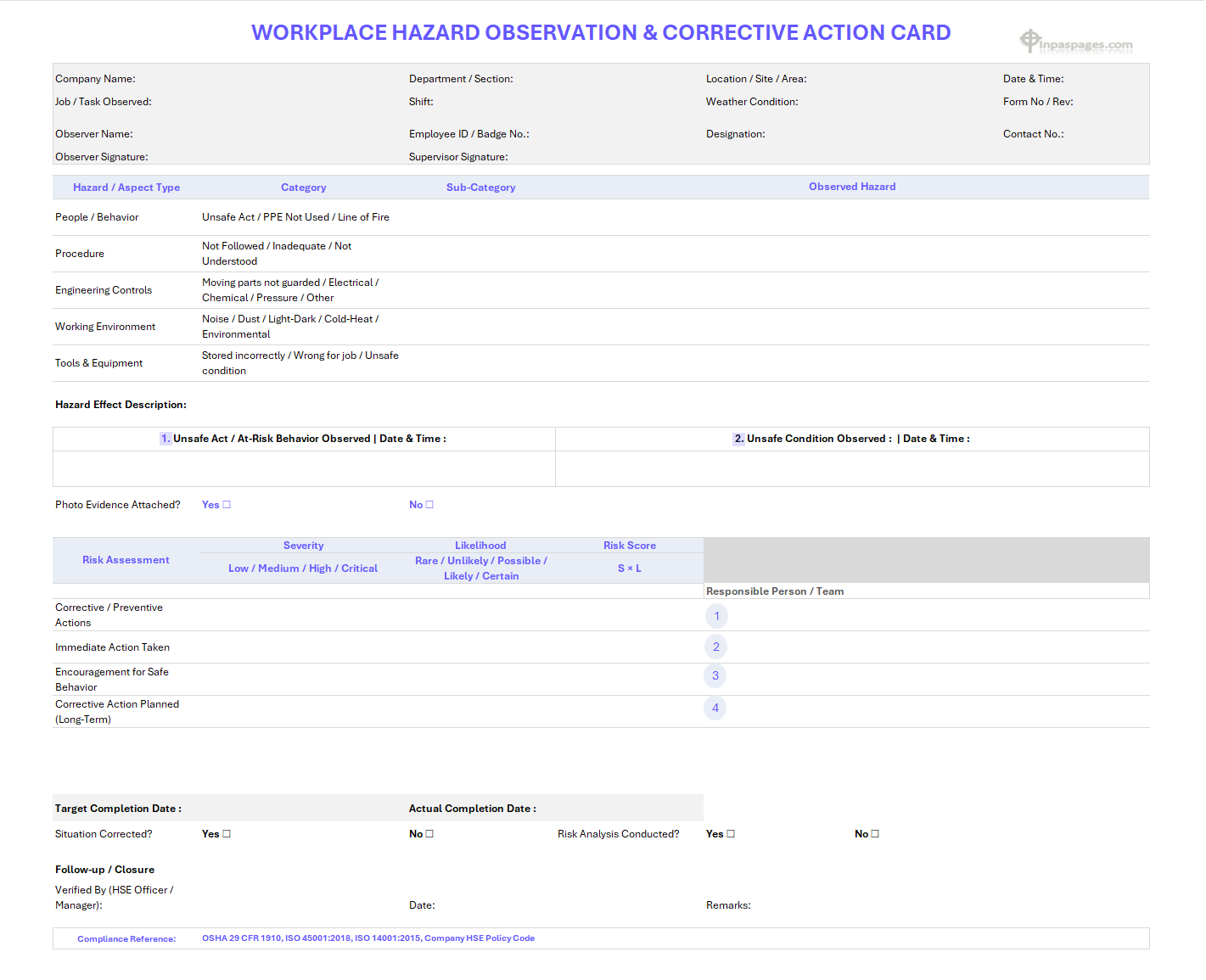
A Hazard Observation Card is a document that plays an important role in workplace safety. When regular observations are made to make the workplace safe, they are recorded here. These notes provide basic information for safety officers. Through which it becomes easier to identify hazards early and take corrective action.