
A bill of materials(BOM) is a list of materials for manufacturing process or assembly line. It may contain components, parts, sub-assemblies, chemicals etc. Bill of material (BOM) is the part of the planning, before the start production. The BOM need to be prepared to ensure the requirements from customers, requirements of organizations, requirements for final the material to concern product.
Bill of material is like a common billing that we made the product list with part No, item description, and quantity for the specific bill of the material for particular customers or product or process.
Key Highlights
- Includes a comprehensive list of all materials and components required for manufacturing.
- Serves as a crucial reference document for production management, detailing part numbers, descriptions, specifications, and material specifics.
- Facilitates the planning, procurement, purchasing, and availability assurance of required materials.
- Reduces the risk of material shortages and production delays, thereby maintaining consistency and accuracy in processes.
- Provides a structured framework for the production area, simplifying stock control and material traceability.
Production peoples are referring the bill of material before the start production line, they requisition the requirements to stores & purchase to concern to avoid production disturbance.
What is its significance in manufacturing sectors?
It serves as a common source of information for these departments, detailing the components required to execute manufacturing processes.
- It enables better planning of materials used across various production lines.
- Helps to improves purchasing accuracy by minimizing stock and inventory issues.
- It is beneficial for optimizing production costs, reducing errors, enhancing efficiency, ensuring traceability, and minimizing material waste.
Simply Bill of material is list of required all the material for the produce any material for specific customer for specific, possible different customers but for product bill of material can be same.
Format of Bill of Materials (BOM)
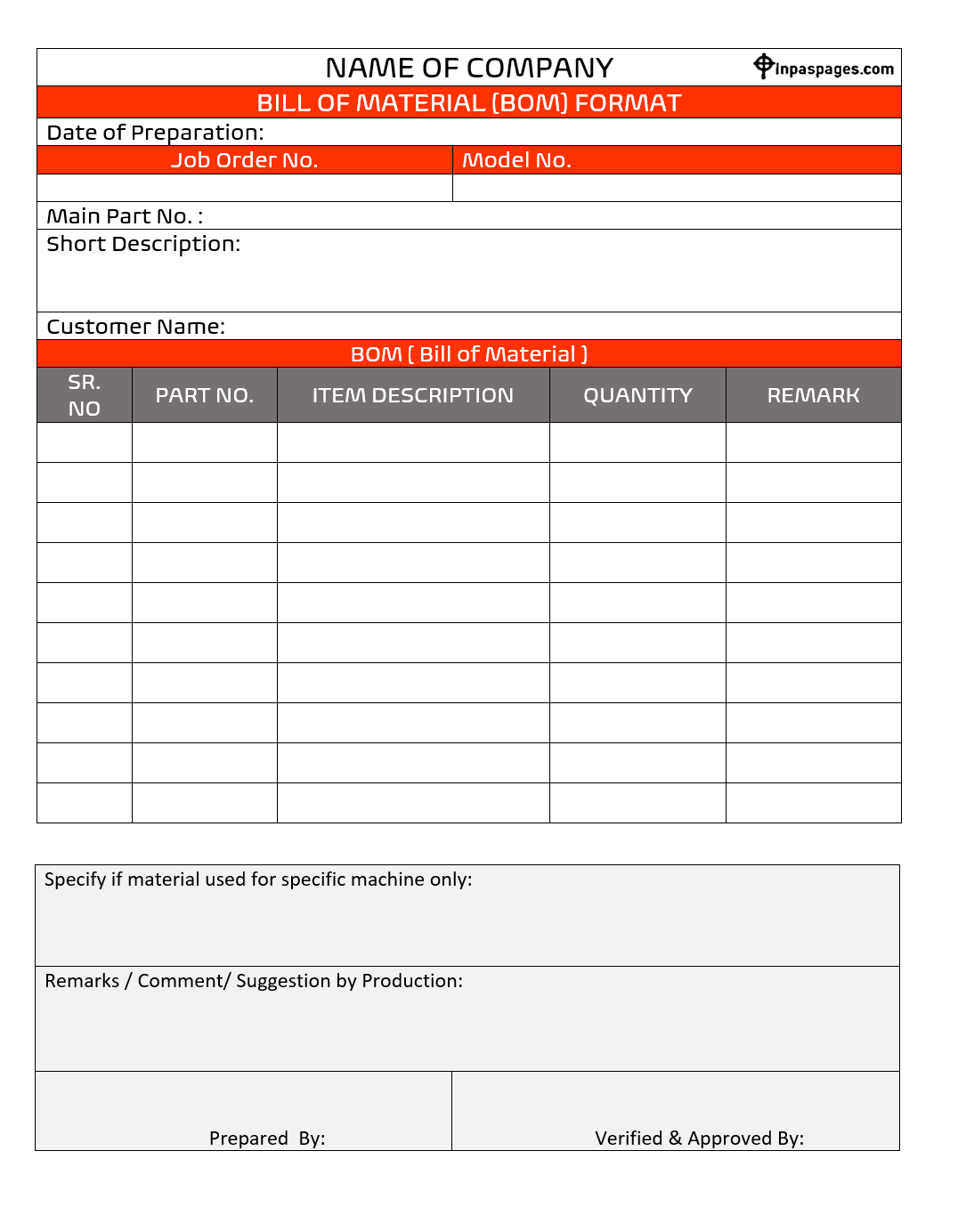
What information can be included in this format?
We can see the format above; it contains some information that is very useful for small-scale businesses. However, if we wish to present all possible information regarding the Bill of Materials in a single format, it could look like this:
- First, the serial number.
- Component, item reference number, or part number.
- A description of its specifications.
- Information regarding the quantity required in the production area.
- The unit of measurement.
- In the case of an assembly or sub-assembly, the drawing number and its revision number.
- Information regarding the procurement of materials, if necessary.
- Details such as the specific material, location, quantity, process involved, supervisor, and operator.
- Additionally, special details, notes, or supplementary information can be included.
Thus, this format serves as a comprehensive repository of specific information, catering to both the interests and objectives of the production sector.
What are the different types of BOMs?
Essentially, a Bill of Materials (BOM) is a list of materials and a vital source of information for the assembly line in the manufacturing sector. Consequently, it can vary based on specific requirements, as outlined below:
Manufacturing BOM (MBOM)
This is a very common and widely used type of BOM in the manufacturing industry. It is prepared by the planning team and contains the information necessary to complete the production processes.
It includes details regarding raw materials, manufacturing assemblies and sub-assemblies, required components, packaging materials, and other production-related information.
Service BOM
It is important to note that while an MBOM is product-centric, a Service BOM is service-oriented. It is specifically created to facilitate maintenance, servicing, repairs, and spare part replacement activities.
- It includes components and spare parts that can be replaced.
- Provides comprehensive information on service assemblies.
- The lists the equipment and items essential for maintenance.
- It may also include a list of recommended items for part replacements. General Usage Information
Single-Level and Multi-Level BOM
Generally, a single-level BOM lists only the immediate components required for an assembly, whereas a multi-level BOM creates a hierarchical structure encompassing multiple levels of assemblies and sub-components. Consequently, the single-level format is used for simple, straightforward products, while the multi-level format covers complex scenarios involving sub-assemblies or multi-stage processes.
Engineering BOM (EBOM)
It is important to note that this type is created for a specific purpose. It encompasses the product’s design and all related components—such as design specifications, references, revisions, associated parts, part numbers, and so on.
These are the various types of Bills of Materials. We have not discussed every single type here, as the ones mentioned are the most practical and widely used.
———————————————————–x ———————————————————–
BOM – Bill of Material Samples, Examples, Description Download
BOM – Bill of Material Format in Word documents
Bill of Material [BOM] Documents requirements in ISO
———————————————————–x ———————————————————–