
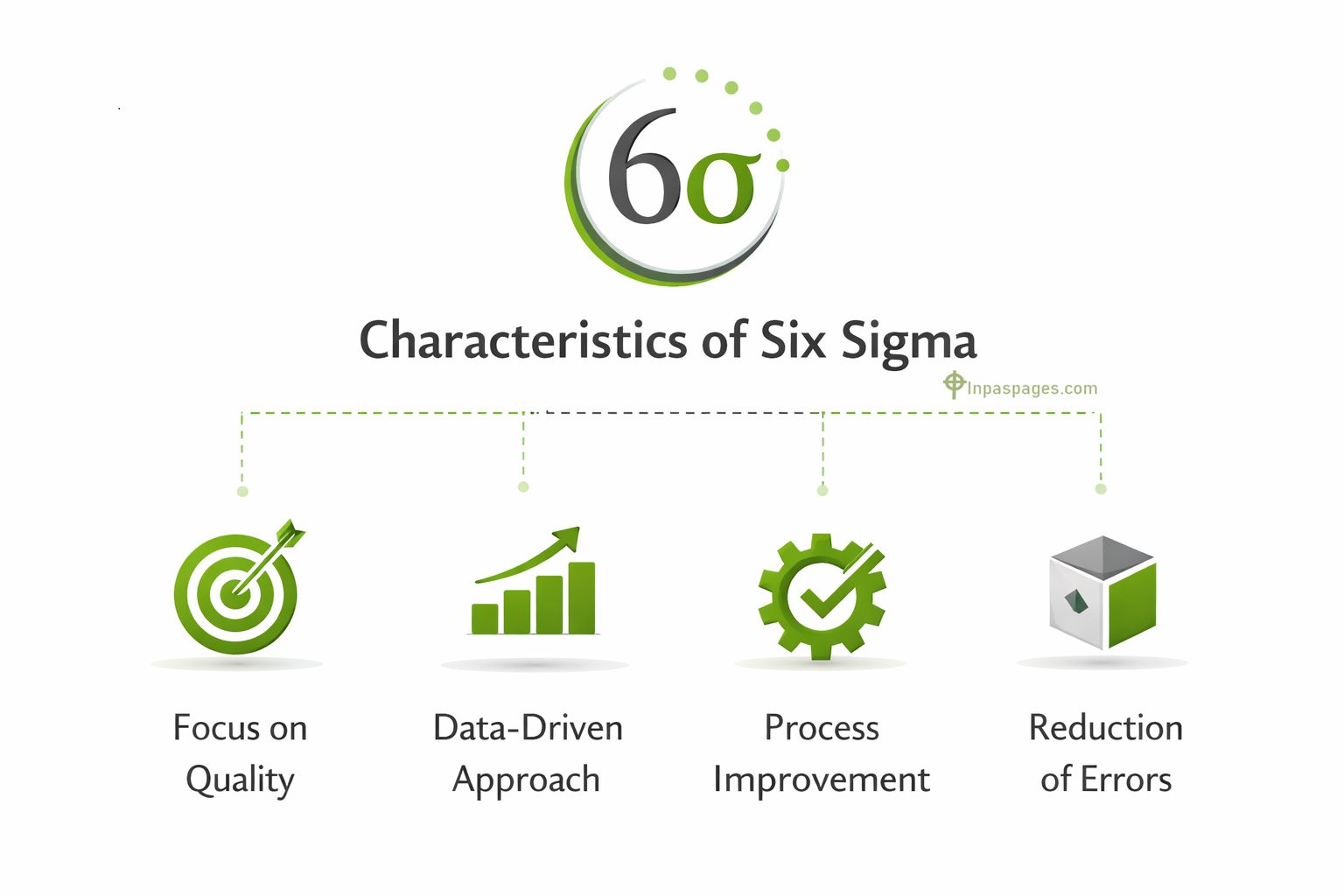
Characteristics of Six Sigma: The Six Sigma is a key business strategy and quality management tool and concept.
Which is used to measure the performance of production, or any other industrial process based on its conformance to a given standard and the nonconformance rate.
Statistical Quality Control
The concept of Six Sigma has a quantitative and statistical aspect. Six Sigma (6σ) is clearly derived from the Greek letter σ (Sigma) from the Greek alphabet. Which is used to denote Standard Deviation in Statistics.
Standard Deviation is used to measure variance. Which is an important tool for measuring non-conformance as far as the quality of the output is concerned.
But the concept suggests that processes barely remain focused on their target standard and tend to deviate. Learning about and overcoming these deviations is what the Six Sigma is all about.
Quality Managers recognize Six Sigma as the measure of progress using process capability analysis. In fact, Six Sigma refers to a specification of a process capability.
When the conformance rate becomes 99.9999998% and the non-conformance rate being 0.002, meaning 2 defects out of billion units.
This is not perfect, but very close to it. This standard offers companies precise idea in terms of statistics about the quality of their output and to study how it can be achieved.
Methodical Approach
The Six Sigma is not merely a quality improvement strategy in theory. As it features a well defined methodical approach of application in DMAIC and DMADV.
Which can be use to improve the quality of production. DMAIC is an acronym for Design-Measure-Analyze-Improve-Control.
The alternative method DMADV stands for Design-Measure-Analyze-Design-Verify.
A number of tools are use by Quality Managers to help them in studying and improving the process capability of their production.
Managers employing the Six Sigma use tools such as:
- Histograms
- Pareto Analysis
- Process Control Charts
- Correlation and Benchmarking.
For establishing better understanding and to help in problem solving.
Fact and Data Based Approach
The statistical and methodical aspects of Six Sigma show the scientific basis of the technique.
This accentuates an important aspect of Six Sigma that it is fact and data base. But quality managers require information in certain specific orders. Which allows them to control the quality of a process as well as critically study it.
They use tools such as sampling, correlation, and standard deviation in this regard.
Project and Objective Base Focus
The Six Sigma process is implement for an organization’s project tailored to its specifications and requirement.
The process is flexed to suit the requirements and conditions in which a project is operating to get the best results.
Tools like Design for Six Sigma enable quality managers to implement it as per the specifications of a particular process.
Apart from that, the Six Sigma is also objective base. The management needs some incentive to invest in the Six Sigma process.
It is aim to enhance profitability and to generate financial.
Tools such as performance indicators can offer managers a good idea about how this quality management, and industrial production technique is working for them.
The Customer Focus
The customer focus is fundamental to the Six Sigma approach. The quality improvement and control standards are based on the explicit customer requirements.
Some industries and businesses which deal in delivering critical value to the customers. Involve great risk in terms of health and security have to strive to accomplish near perfect process capability and go for Six Sigma.
Teamwork Approach to Quality Management
The Six Sigma process requires organizations to get organize when it comes to controlling and improving quality. Six Sigma actually involves a lot of training depending on the role of an individual in the Quality Management team. The roles in Six Sigma teams are assign based on the ranks in Karate, such as:
- Green Belts which are Project Leaders
- Black Belts training and assisting Green Belts
- While Black Belts undergoing individual coaching sessions from
- Master Black Belt, who are the technical leaders and master trainers of the Quality Management team.